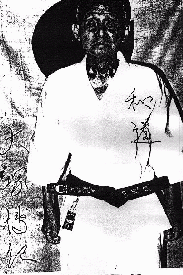
Founder of the Wado style, Sensei Ohtsuka began martial arts training at six in Shindo Yoshin-ryu jujutsu, a traditional Japanese martial art from which modern judo was derived. By 1921, at the relatively young age of 29, he was awarded the coveted menkyo-kaiden, designating him the successor as master of this style. A year later he began karate training under Gichin Funakoshi, the man who introduced karate to Japan from Okinawa. He became one of Funakoshi's senior students but eventually travelled to Okinawa to learn more deeply of karate from the masters who had instructed Funakoshi. It was his belief that Funakoshi had over-simplified and over-modified several karate techniques and katas in the interests of teaching large groups of beginners. Sensei Ohtsuka combined his new knowledge of karate with several of his own adaptations from Japanese Bushido (the Way of the Warrior) martial arts to form Wado karate.
Sensei Ohtsuka founded Wado karate in 1931, which has become one the four major styles of Japanese karate, the others being: Shotokan, Shito, and Goju. In the same year, Sensei Ohtsuka organized the All Japanese Katate-do Federation, Wado-Kai, which serves as the worldwide sanctioning body for Wado karate and it's affiliates. As early as 1934 he had developed rules and regulations for competitive free sparring to be incorporated into his system, the first karate style to do so. These rules have been wholly or patially adopted by virtually all modern martial arts competitions. In 1972, Sensei Ohtsuka recieved the highest Japanese decoration from the Emperor for his contribution to karate as well as being designated the head of all martial arts systems within the All Japan Karate-do Federation.
