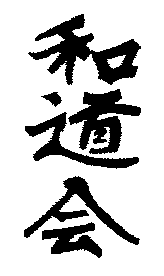
The Wado-Ryu (Way of Peace) school of karate, was founded in 1931 by the late grand master Hironori Ohtsuka (1892-1982).
Ohtsuka Sensei was already an accomplished master of JuJitsu, Shindo Yoshin Ryu, when master Gichin Funakoshi introduced karate in Tokyo, Japan. Master Ohtsuka became interested in karate in 1922. By 1928, he was assistant instructor to Funakoshi Sensei. In 1931 master Ohtsuka founded the Wado-Ryu style of karate. In 1972, Ohtsuka Sensei was awarded the title Shodai Karate-do meijin Judan (the greatest title possible) from the Imperial Japanese family. This means first generation karate master of the 10th dan; he was the first Japanese (not Okinawan) to make a style of karate in the form of Japanese budo, thus making it a true Japanese martial art. Master Ohtsuka also received the Shiju Hooshu medal for his outstanding contributions to sport from the government of Japan. He was the only man ever in the history of karate to be so honoured.
Wado kai or ryu, meaning the "way of peace and harmony", is one of the four major styles of karate in Japan and perhaps the purest form of karate-do (the way of the empty hands).
The aim of Wado karate is not merely perfection of the physical techniques of self-defense, but, the development of a mind that is tranquill yet alive, able to react intuitively to any situation. In Wado, as skill and knowledge are aquired through training and concentrated effort, the student is expected to develop inner strength and calmness of character, as well as the virtues of self-control, respect for others, and true humility. Karate-do for Sensei Ohtsuka is primarily a spiritual disipline.
Basic techniques - punching, kicking, blocking, striking with open hand, joint twisting, and trapping techniques - kata (a sequence of techniques done in certain order against imaginary opponents), and prearranged and free style sparring comprise the training foundation of this style. Equally fundamental to Wado is taisabaki, body shifting to avoid the full brunt of an attack, a technique derived from Japanese swordmanship. Kumite (sparring) is usually judged on a point system; one referee and four corner judges determine which techniques are given a point. In free sparring, there is no contact allowed to the head, below the waist except for foot sweeps, or to the spine; only light to medium contact is allowed to the torso. Attacks to the head and torso can all score points in a tournament, therefore, Wado karate-ka tend to fight with explosive, close movements with an emphasis on well-controlled techniques.
